Tell us about the job
Takes about a minute. No obligation.
A contractor quoting a mini-split repair in Buncombe County has to work out whether the system wore down from use and age or from something the weather put it through. 88 severe weather events were recorded in Buncombe County, North Carolina between 2015 and 2024. That rate puts severe weather in the county at a real but unremarkable presence, not a punishing one, so the outdoor unit's history of service and how well it was maintained carry more weight in a diagnosis than the regional storm count. Coil condition, refrigerant level, and how long the system has been running are where the inspection starts.
What a mini-split repair turns on, once the unit is open, is whether the parts that system takes are still made and stocked. Half the homes in Buncombe County, North Carolina were built in 1991 or earlier (2020-2024 ACS 5-year). A house that age has seen at least one equipment cycle already, which means the hardware inside a wall-mounted head or outdoor compressor belongs to a generation the manufacturer may have moved past. A contractor pulling a failed control board or a specific expansion valve has to find out fast whether that part ships or whether the repair conversation changes.
The Parts of a Mini-split a Contractor Checks During Repair
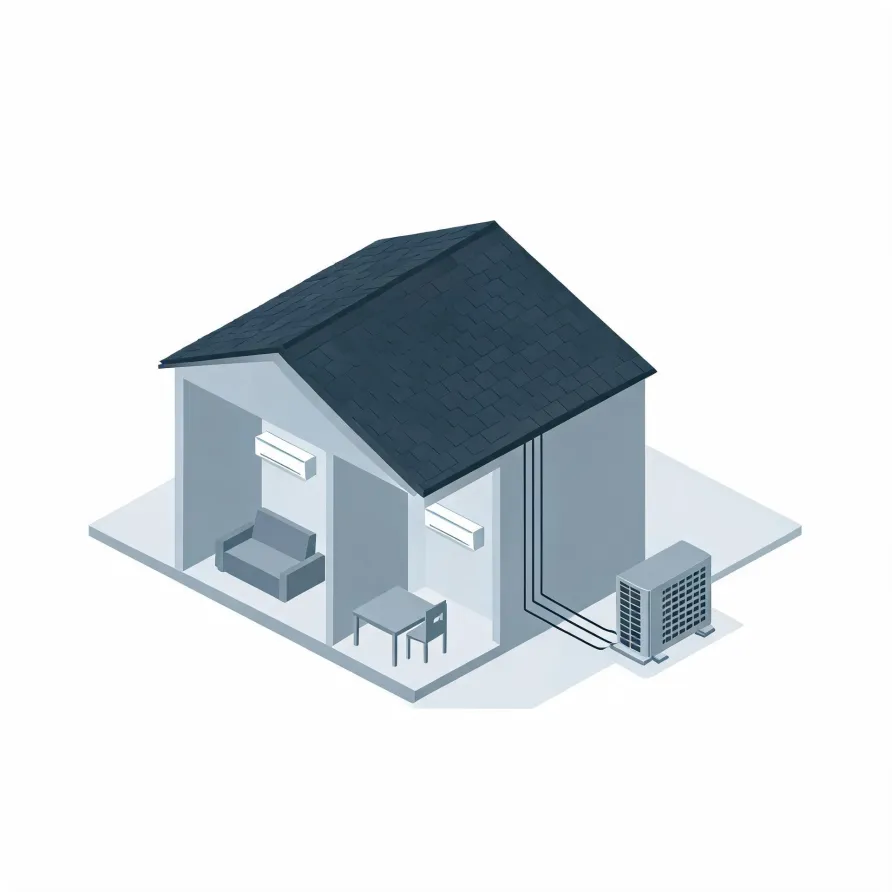
The indoor air handler is the piece most homeowners notice first, mounted high on a wall inside the room it serves. It holds the evaporator coil, a blower fan, and a filter, and when any of those fails the room loses cooling or heating, starts producing unusual sounds, or begins leaking water down the wall.
Outside, the condenser unit houses the compressor and the outdoor coil, and these are the components a contractor turns to when a system runs but moves no heat at all. A refrigerant line set and a condensate drain line run between the two units, and a fault anywhere along that path, whether a slow refrigerant leak or a blocked drain, shows up as a symptom inside the house.
The drawing alongside shows the general layout of a mini-split system, and a licensed contractor determines which components apply to your specific installation.
Find a contractor in Buncombe CountyBuncombe County by the Numbers
88 severe weather events were recorded in Buncombe County, North Carolina between 2015 and 2024.
NOAA National Centers for Environmental Information, Storm Events Database, bulk CSV export, events 2015-01-01 through 2024-12-31.Half the homes in Buncombe County, North Carolina were built in 1991 or earlier (2020-2024 ACS 5-year).
U.S. Census Bureau, 2020-2024 American Community Survey 5-Year EstimatesBuncombe County, North Carolina holds 134,483 housing units (2020-2024 ACS 5-year).
U.S. Census Bureau, 2020-2024 American Community Survey 5-Year EstimatesOwners occupy 66.2% of the occupied homes in Buncombe County, North Carolina (2020-2024 ACS 5-year).
U.S. Census Bureau, 2020-2024 American Community Survey 5-Year EstimatesCodes & Standards Covering Mini-Split Repair in Buncombe County, North Carolina2 sourced rules and standards
Licensing Rules for HVAC Repair in Buncombe County, North Carolina
North Carolina issues Class I heating licenses covering all systems in all structures, and Class II licenses covering heating systems in single-family detached residential dwellings.
North Carolina requires a license before any person or firm may engage in, or offer to engage in, the business of heating contracting.
Severe Weather Events in Buncombe County
Weather puts real load on heating and cooling equipment, and the stress it delivers varies by place. Mini-split repair needs in Buncombe County are shaped in part by what the local climate asks of the hardware.
88 severe weather events, 2015–2024. Source: NOAA National Centers for Environmental Information, Storm Events Database.