Tell us about the job
Takes about a minute. No obligation.
A contractor called out to repair a mini-split in Graham County is not working in a place where the weather has been grinding equipment down season after season. 32 severe weather events were recorded in Graham County, North Carolina between 2015 and 2024. At that rate, severe weather is an occasional event in a system's life, not a steady background pressure on its components. What wears out a mini-split here is likelier to be a poor original install, a refrigerant charge that was never right, or a compressor that has simply run its years. The weather record is real, and a contractor accounts for it, but it does not explain most of what they find.
A house built decades before mini-splits existed will have had its system added later, which means the refrigerant type, the board, and the drain line are all younger than the walls around them. Half the homes in Graham County, North Carolina were built in 1989 or earlier (2020-2024 ACS 5-year). What a contractor finds once the head or the outdoor unit is opened decides the repair scope: whether the refrigerant charge is recoverable, whether a board is still manufactured, whether a drain path was routed to handle the condensate load the system actually produces. The building's age does not answer any of those questions.
The Parts of a Mini-Split a Contractor Checks During Repair
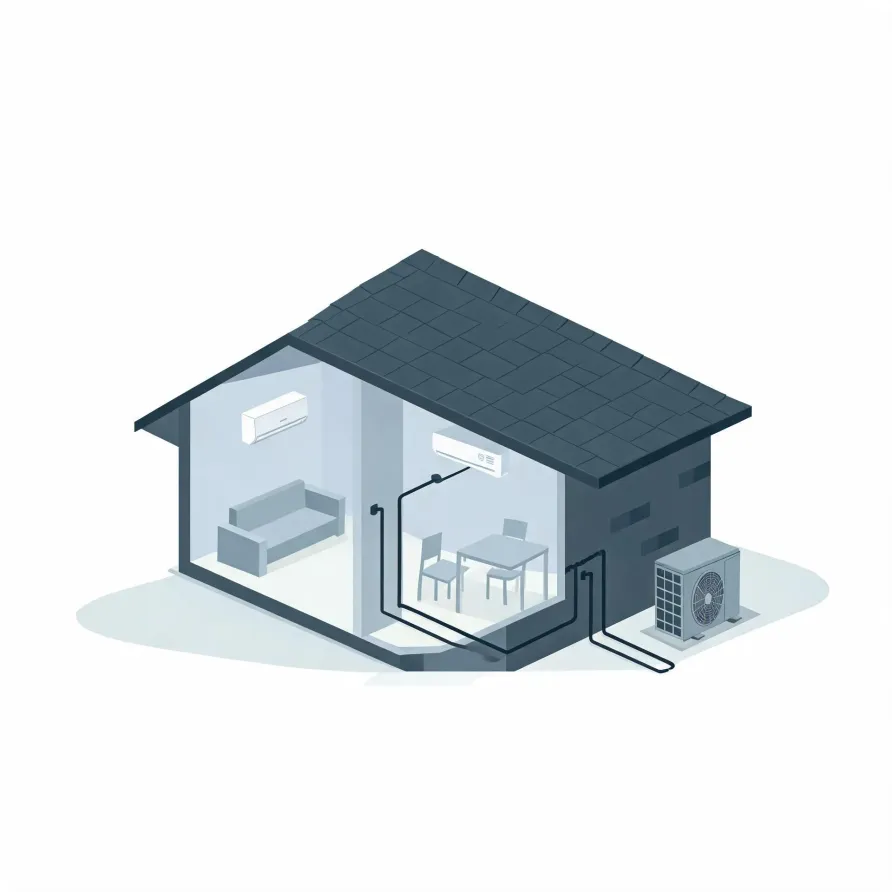
The indoor air handler mounts high on a wall inside the room and is the piece a homeowner sees every day. It holds the evaporator coil, the blower fan, and the filters that move conditioned air into the space. When the system blows warm air, makes noise, or leaks water, this unit is where a contractor looks first.
The outdoor condenser unit sits on a pad or bracket outside the house and holds the compressor and condenser coil. A refrigerant line set runs between the two units through a small opening in the wall, and a condensate drain line carries moisture away from the indoor head. Faults in the compressor or a refrigerant leak show up in the outdoor unit, while drain line clogs trace back to the indoor side.
The drawing shows a typical layout, and a licensed contractor determines which components and conditions apply to your specific house.
Find a contractor in Graham CountyGraham County, by the numbers
32 severe weather events were recorded in Graham County, North Carolina between 2015 and 2024.
NOAA National Centers for Environmental Information, Storm Events Database, bulk CSV export, events 2015-01-01 through 2024-12-31.Half the homes in Graham County, North Carolina were built in 1989 or earlier (2020-2024 ACS 5-year).
U.S. Census Bureau, 2020-2024 American Community Survey 5-Year EstimatesGraham County, North Carolina holds 5,240 housing units (2020-2024 ACS 5-year).
U.S. Census Bureau, 2020-2024 American Community Survey 5-Year EstimatesOwners occupy 80.7% of the occupied homes in Graham County, North Carolina (2020-2024 ACS 5-year).
U.S. Census Bureau, 2020-2024 American Community Survey 5-Year EstimatesRepair Rules & Licensing Standards for Mini-Split Work in Graham County, North Carolina2 sourced rules and standards
Licensing Rules for HVAC Repair in Graham County, North Carolina
North Carolina issues Class I heating licenses covering all systems in all structures, and Class II licenses covering heating systems in single-family detached residential dwellings.
North Carolina requires a license before any person or firm may engage in, or offer to engage in, the business of heating contracting.
Severe Weather Events in Graham County
Graham County's climate puts real stress on heating and cooling equipment over time. How hard a mini-split has worked, and what repairs it may need, is shaped by the weather it has run against.
32 severe weather events, 2015–2024. Source: NOAA National Centers for Environmental Information, Storm Events Database.