Tell us about the job
Takes about a minute. No obligation.
Before a contractor can say what failed in a mini-split here, they have to sort out what drove the failure. 117 severe weather events were recorded in Catawba County, North Carolina between 2015 and 2024. At that rate, severe weather is a standing condition in this area, not an occasional event, and it puts a real cumulative load on refrigerant lines, contactors, and drain components. A system that has run against that kind of weather history may show wear that looks like a manufacturing defect or a refrigerant leak that looks like a slow charge-down from installation. The contractor checks what the weather could plausibly have worked on before pricing anything else.
A mini-split installed into an older house carries its own parts history, separate from the walls around it. Half the homes in Catawba County, North Carolina were built in 1985 or earlier (2020-2024 ACS 5-year). Housing that age was built for different equipment, but the mini-split a contractor opens today was added later, so what decides the repair is what that unit actually contains and whether the refrigerant fittings, circuit boards, or compressor components it takes are still in production. A discontinued part means a longer sourcing delay or a decision about replacement.
The Parts of a Mini-Split a Contractor Checks During Repair
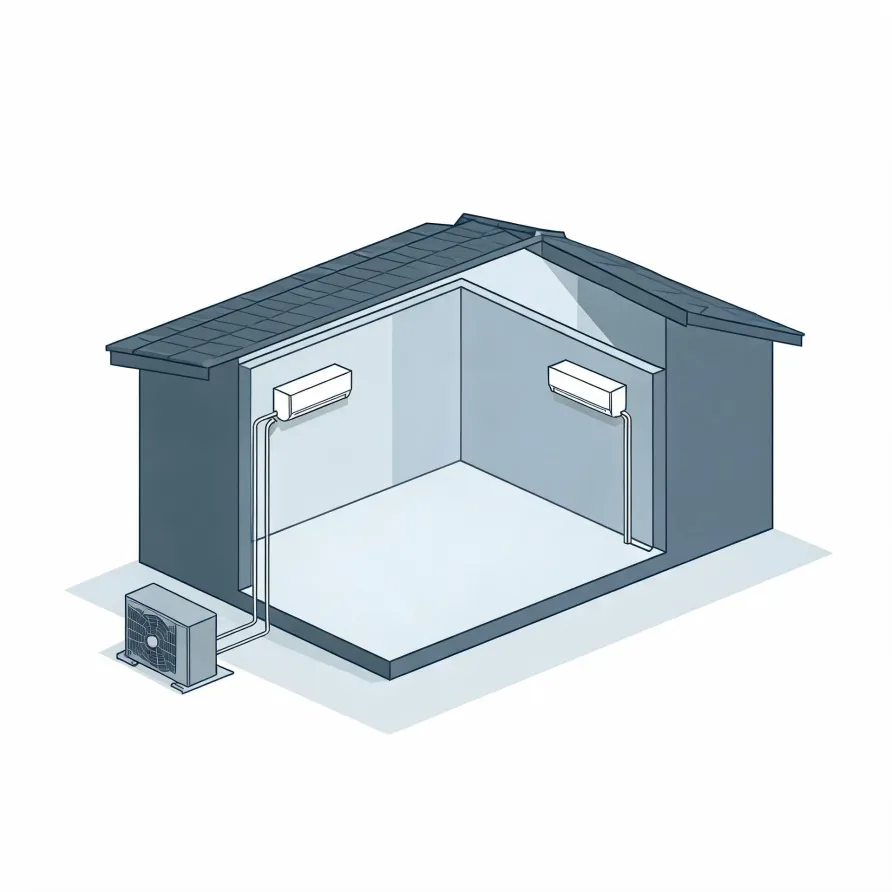
The indoor air handler mounts high on a wall inside the room and is the piece a homeowner notices first. It holds the evaporator coil, a blower fan, and a filter. When any of those fail, the unit may blow warm air, drip water onto the wall, or run without moving much air at all.
Outside the house, the compressor and condenser coil sit in the outdoor unit. A refrigerant line set and a control wire run through the wall to connect the two. The outdoor unit is where a contractor looks when the system runs constantly without reaching the set temperature, or when it shuts off before the cycle should end.
The drawing shows the general layout of a mini-split system, and a licensed contractor determines which components apply to your specific installation.
Find a contractor in Catawba CountyCatawba County, by the numbers
117 severe weather events were recorded in Catawba County, North Carolina between 2015 and 2024.
NOAA National Centers for Environmental Information, Storm Events Database, bulk CSV export, events 2015-01-01 through 2024-12-31.Half the homes in Catawba County, North Carolina were built in 1985 or earlier (2020-2024 ACS 5-year).
U.S. Census Bureau, 2020-2024 American Community Survey 5-Year EstimatesCatawba County, North Carolina holds 73,133 housing units (2020-2024 ACS 5-year).
U.S. Census Bureau, 2020-2024 American Community Survey 5-Year EstimatesOwners occupy 72.2% of the occupied homes in Catawba County, North Carolina (2020-2024 ACS 5-year).
U.S. Census Bureau, 2020-2024 American Community Survey 5-Year EstimatesCodes & Standards Governing Mini-Split Repair in Catawba County, North Carolina2 sourced rules and standards
Licensing Rules for HVAC Repair in Catawba County, North Carolina
North Carolina issues Class I heating licenses covering all systems in all structures, and Class II licenses covering heating systems in single-family detached residential dwellings.
North Carolina requires a license before any person or firm may engage in, or offer to engage in, the business of heating contracting.
Severe Weather Events in Catawba County
Weather puts real load on heating and cooling equipment, and that load adds up over time. Mini-split systems in Catawba County work against whatever the local climate brings, and repair needs here are shaped by that history.
117 severe weather events, 2015–2024. Source: NOAA National Centers for Environmental Information, Storm Events Database.