Tell us about the job
Takes about a minute. No obligation.
A contractor quoting a mini-split repair in Cumberland County works through a short list of likely causes before weather enters the conversation. 132 severe weather events were recorded in Cumberland County, North Carolina between 2015 and 2024. At roughly the sixty-seventh percentile nationally, that puts this county in the upper half of the distribution, but not at the extreme where storm load alone would explain a failing compressor or a refrigerant issue. Age of the equipment and the quality of the original installation account for most of what contractors find when they open a system here. Maintenance history closes the gap.
Half the homes in Cumberland County, North Carolina were built in 1988 or earlier (2020-2024 ACS 5-year). A mini-split retrofit fitted to a house of that vintage sits inside mounting decisions made for different equipment, and the adapted refrigerant lines, drain routing, and wall penetrations age on their own schedule. When something fails, the opened unit often shows a symptom whose real source is in that surrounding work. A contractor tracing the fault checks those adapted connections before pricing parts, because a component swap without finding that source leaves the underlying cause in place.
The Parts of a Mini-split a Contractor Checks During Repair
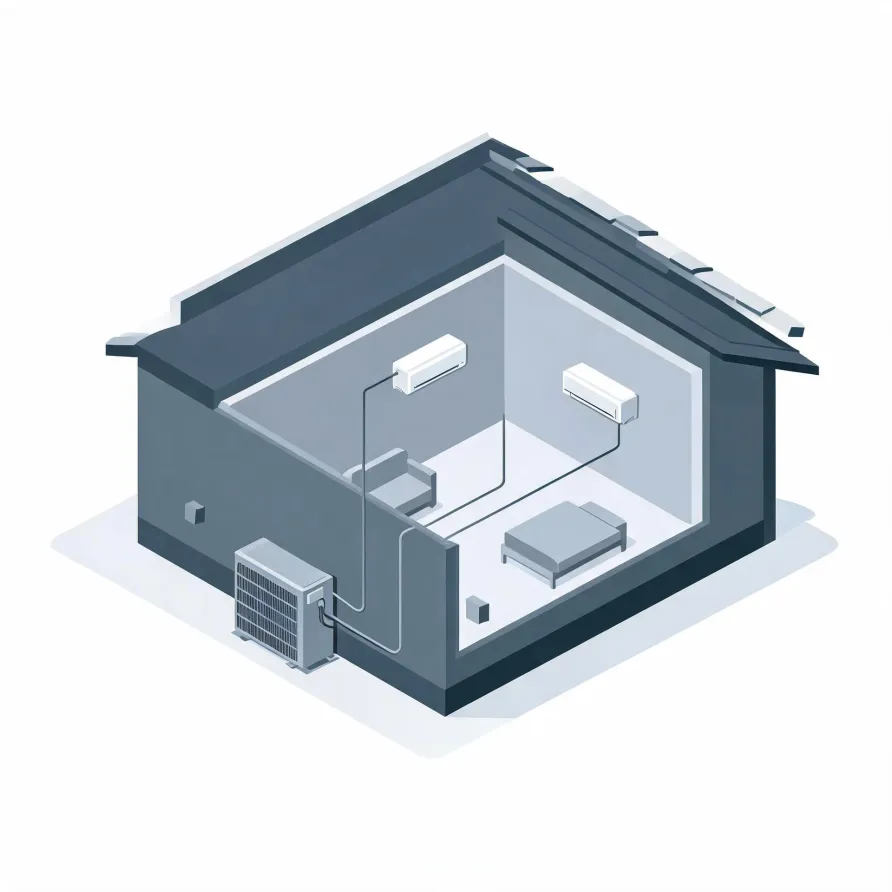
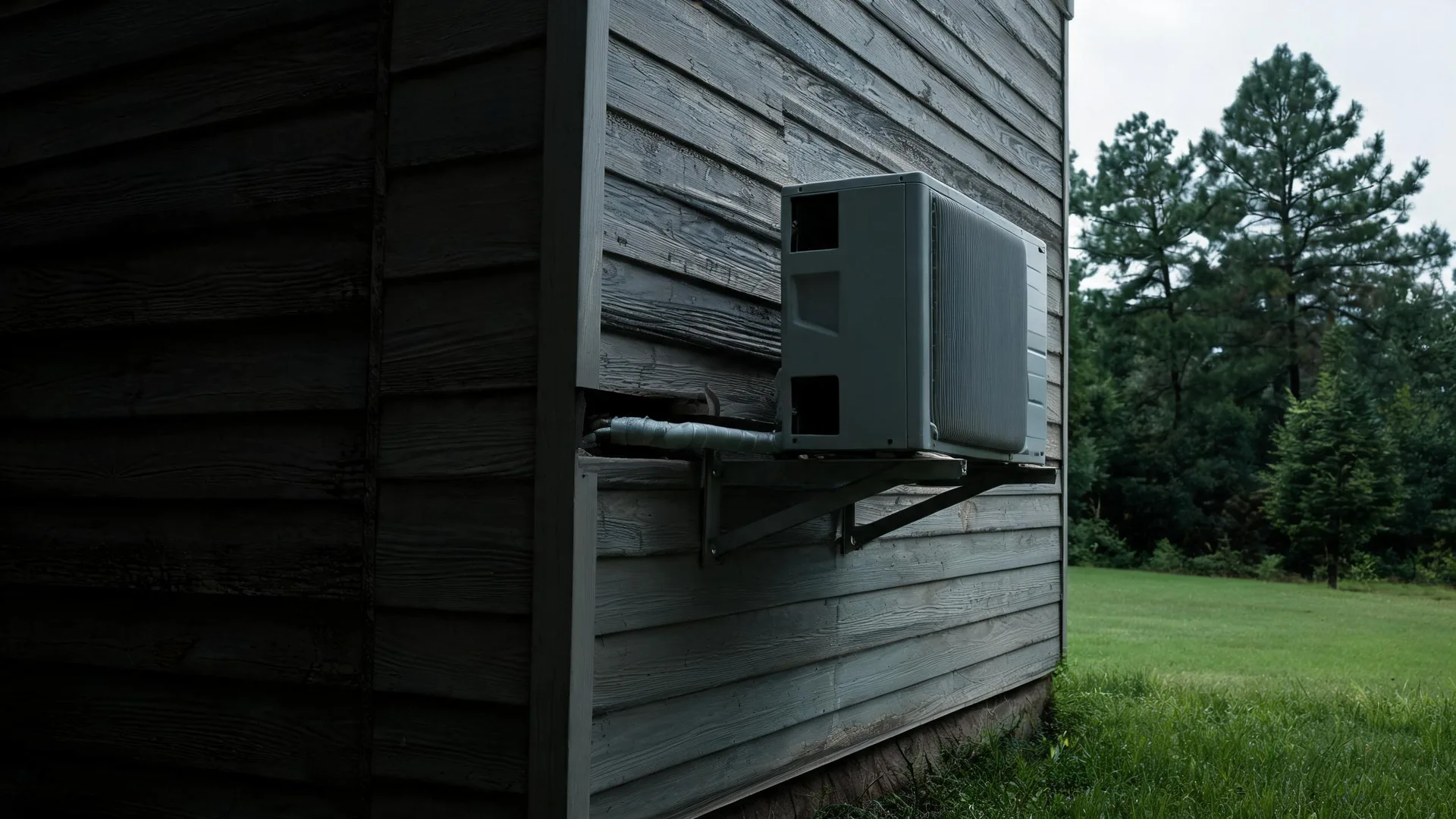
The indoor air handler mounts high on an interior wall and is what most homeowners see and interact with daily. It pulls room air across a coil, and when it malfunctions the symptoms show up fast: weak airflow, warm air where cool air should be, or ice on the coil itself. The outdoor condenser unit sits outside the house and is where a contractor often starts tracing a problem back to its source.
A refrigerant line set runs through a small hole in the wall and connects the indoor and outdoor units. The condensate drain line carries moisture away from the indoor handler, and a blocked drain is one of the more common causes of water damage or a unit shutting itself off. Each of these connections is a point a contractor examines when diagnosing why a system has stopped working correctly.
The drawing shows a general layout of how these pieces relate to one another, and a licensed contractor determines which components are relevant to the specific system and conditions in your home.
Find a contractor in Cumberland CountyCumberland County, by the numbers
132 severe weather events were recorded in Cumberland County, North Carolina between 2015 and 2024.
NOAA National Centers for Environmental Information, Storm Events Database, bulk CSV export, events 2015-01-01 through 2024-12-31.Half the homes in Cumberland County, North Carolina were built in 1988 or earlier (2020-2024 ACS 5-year).
U.S. Census Bureau, 2020-2024 American Community Survey 5-Year EstimatesCumberland County, North Carolina holds 143,798 housing units (2020-2024 ACS 5-year).
U.S. Census Bureau, 2020-2024 American Community Survey 5-Year EstimatesOwners occupy 55.0% of the occupied homes in Cumberland County, North Carolina (2020-2024 ACS 5-year).
U.S. Census Bureau, 2020-2024 American Community Survey 5-Year EstimatesCodes & Standards Covering Mini-Split Repair in Cumberland County, North Carolina2 sourced rules and standards
Licensing Rules for HVAC Repair in Cumberland County, North Carolina
North Carolina issues Class I heating licenses covering all systems in all structures, and Class II licenses covering heating systems in single-family detached residential dwellings.
North Carolina requires a license before any person or firm may engage in, or offer to engage in, the business of heating contracting.
Severe Weather Events in Cumberland County
Weather puts real load on heating and cooling equipment, and Cumberland County's climate is local in ways a national average won't capture. How hard a mini-split works, and how often it needs attention, is tied directly to what the weather outside actually does.
132 severe weather events, 2015–2024. Source: NOAA National Centers for Environmental Information, Storm Events Database.